Tom Hagen
The GodfatherTom Hagen is the Corleone Family’s adopted son in all but formal legal name, its lawyer, and its most important subordinate officer. As Vito Corleone’s Consigliere, he stands between the Don’s private decisions and the men who execute them, converting personal loyalty into an organized system of orders, favors, information, and protection. His life traces both the strength of that system and its cost: the family saves him from abandonment, gives him wealth and authority, and finally narrows his authority when Michael Corleone reshapes the organization for its future in Las Vegas.
Identity and Background
Tom Hagen is thirty-five years old when the narrative presents him as a tall, crew-cut, very slender, ordinary-looking man. He is a lawyer who passed the bar examination and practiced law for three years, although he does not perform the detailed legal work of the Corleone family business. His professional appearance conceals a history of severe deprivation. His mother became blind and died during his eleventh year; his father, a hardworking carpenter who had never committed a dishonest act, became a hopeless drunkard whose drinking destroyed the household and eventually killed him. Tom was left an orphan, while his younger sister was placed in foster care.
The orphaned boy wandered the streets and slept in hallways. He also suffered from an eye infection, and neighbors treated him as a source of contagion because they believed he had caught or inherited it from his mother. Sonny Corleone, then an imperious but warmhearted eleven-year-old, brought his playmate home and demanded that the family take him in. Tom was given a hot dish of spaghetti with rich tomato sauce and a metal folding bed, a small domestic welcome that remained unforgettable because it marked the end of his homelessness.
Tom’s incorporation into the household was intimate but not formally defined. Michael Corleone explains that Tom lived with the family from the age of twelve, after his parents died and he had nowhere else to go, and stayed until he married. Michael also makes clear that Tom was not legally adopted: he simply lived with them. That distinction reveals the family’s characteristic form of belonging. Kinship can be created through shelter, shared meals, loyalty, and obligation even when it is not certified by law.
Consigliere and the Architecture of Power
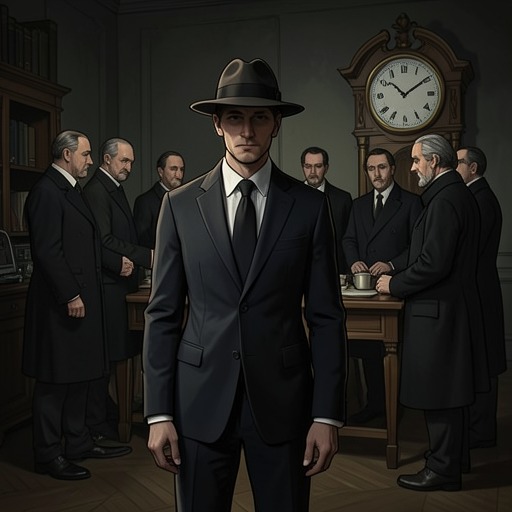
At the wedding of Constanzia Corleone, Tom watches the festivities from behind the closed window of Vito Corleone’s office, whose walls are stacked with law books. He is Vito’s lawyer and acting Consigliere, the counselor who occupies the most vital subordinate position in the family business. The office is not merely a workplace: it is where Tom and Vito have solved difficult problems together, and Tom understands that when the Don leaves the celebration to enter the house, business will continue even on a family wedding day.
The Consigliere’s authority depends on proximity to the Don. Tom is Vito’s counselor, right-hand man, auxiliary brain, closest companion, and closest friend. He knows nearly everything Vito knows, including the family’s many centers of power. On important journeys he drives Vito’s car; at conferences he fetches refreshments, coffee, sandwiches, and cigars. Such tasks do not diminish him. They demonstrate a personal service relationship in which access, trust, and discretion are the foundations of command.
His office also protects the distance between Vito and violence. Vito gives instructions privately to Tom; Tom later passes them privately to a caporegime such as Peter Clemenza; Clemenza tells Paulie Gatto to carry out the commission. The operative at the end of the chain does not know why the task is being performed or who ordered it. Each intermediary buffers the Don from the act, while the possibility of betrayal is contained by the threat that a link in the chain may disappear. Tom is therefore both counselor and institutional mechanism: he makes personal rule appear as layered administration.
This appointment breaks a long-standing tradition. The Consigliere had always been a full-blooded Sicilian, because the position was believed to require a man born to the ways of Omertà, the law of silence. Tom’s upbringing inside the Corleone household does not satisfy that blood-based rule, yet Vito chooses him anyway. The decision asserts that loyalty and demonstrated character can outweigh ethnic tradition. It also makes Tom unusually powerful: he is the one man capable of bringing the Don down, but the established code promises that a faithful Consigliere will become rich, wield power, win respect, and have his wife and children protected if misfortune comes.
Friendship, Debt, and the Family Network
Tom’s authority grows from the same moral vocabulary that governs Vito’s wider world. Vito helps people who declare their friendship, whether or not they are already his friends and whether or not they can repay him materially. In return, the recipient owes recognition, respect, and readiness to perform a future service. Tom is the clearest example of this system’s emotional and political force: Sonny’s childhood act of bringing him home becomes a lifelong bond, and the orphan becomes not merely an employee but a member of the family.
The family’s network extends far beyond blood relatives, and Tom is one of its principal connectors. Vito’s organization draws strength from friendships with labor leaders, lawyers, police officials, judges, bankers, and business figures. When Vito establishes a system of monthly payments to officials, he insists that every useful name be placed on the list, even if a particular official cannot help immediately, because friendship must be offered before it is needed. Tom understands and operates within this world of deferred obligation, where a favor is both personal kindness and stored political capital.
At the Corleone peace meeting, a bank president makes a private conference room available because he is indebted to Vito and because Vito owns some of the bank’s stock in the president’s name. The president once offers written proof of that ownership to prevent any possible treachery, but Vito rejects the gesture, saying that his faith in the man would collapse if he believed betrayal possible. Tom belongs to this same economy of trust, though his position also exposes its danger: the Consigliere knows enough to destroy the Don, and the system survives only if knowledge is never converted into treason.
Tom’s social intelligence is especially evident in the Los Angeles mission concerning Jack Woltz. Acting on Vito’s instructions, he contacts Billy Goff, the most powerful man in the movie labor unions, and has him arrange a meeting while hinting that a failure to satisfy Tom could bring a labor strike against Woltz’s studio. Tom avoids making a direct promise when Goff says that, if necessary, he must speak to Vito himself. He also recognizes the weakness of the maneuver: Woltz’s ten o’clock appointment places Tom first on the schedule and excludes him from lunch, signaling that Woltz considers him of little importance. Tom reads both the visible appointment and the hidden network behind it, understanding how official prestige, payroll corruption, personal debt, and Vito’s discreet reputation interact.
The Western Reorganization and Loss of Office
Tom’s position changes when Michael takes control and the Corleone Family begins planning a move from New York to Las Vegas. Michael announces that the family intends to sell its olive-oil interests and settle in Nevada over the course of several years, using friends’ holdings in a hotel and casino as the foundation of its new power. Tom is present at the meeting in Vito’s house with Vito, Michael, Carlo Rizzi, Peter Clemenza, and Salvatore Tessio, but the atmosphere is strained. Vito’s semiretirement and Michael’s succession have unsettled the old hierarchy, while the Barzini Family has become the strongest family in New York and is pressing into Corleone gambling territory.
Michael then removes Tom from the Consigliere position. Tom will move to Las Vegas with his family in about two months, but strictly as the family’s lawyer; from that moment, no one is to bring him any other business. Michael presents the decision as a matter of organizational design rather than personal insult and jokes that, if advice is needed, Vito remains the better counselor. The joke does not soften the message. Tom is being excluded from the power structure he helped build, and the others watch his impassive face to measure the injury.
Tom’s response is controlled rather than theatrical. He asks why he has been cut out and identifies the practical changes behind the formal announcement: Rocco Lampone is building a secret regime without Tom’s knowledge, and Michael is dealing directly with Albert Neri rather than through Tom or a caporegime. Tom has detected the hidden structure by examining payroll records. Lampone’s recruits are reported to him, but the men receive salaries too high for the jobs assigned to them, suggesting that an independent apparatus is being assembled beneath the official organization. Tom even acknowledges that Michael chose Lampone well and that Lampone is operating effectively. His complaint is not wounded vanity alone; it is a precise diagnosis of information being diverted around him.
Michael’s reorganization also loosens the old family structure. Clemenza and Tessio are told that they may remain part of the family but might do better operating independently because most of the strength will move west. Tom’s demotion belongs to the same transformation. The old order depended on Vito’s personal trust and Tom’s comprehensive knowledge; the new order distributes authority among lawyers, security chiefs, caporegimes, and western business interests. Tom remains valuable, but his value is narrowed to law, while strategic power passes elsewhere.
Change, Ending, and Narrative Significance
Tom’s final position is neither exile nor betrayal. After Michael’s victory and a year of political maneuvering, Michael becomes the most powerful Family chief in the United States. The New York operation is closed, the houses and mall property are sold, and the family relocates its center of gravity to Nevada. Tom is part of Michael’s Western Family, while Rocco Lampone serves as a Corleone caporegime, Albert Neri heads security for the family-controlled hotels, and Clemenza has his own Family.
The move confirms Tom’s survival within the family even as it ends his former supremacy. He remains protected by the institution that rescued him, but he no longer occupies the indispensable position between the Don and the operational world. His career therefore expresses the paradox of Corleone loyalty: faithfulness brings security, wealth, and belonging, yet belonging does not guarantee permanent authority when a new leader changes the organization’s needs.
Tom also embodies the family’s tension between personal and formal power. He begins as an unwanted orphan whom Sonny brings across the threshold of the household, becomes Vito’s trusted friend and counselor, and helps translate private favors into a disciplined hierarchy. His legal training, contacts, memory, and discretion make him a bridge between the family’s intimate language of friendship and its increasingly complex network of unions, banks, officials, businesses, and hotels. When Michael moves toward a western and more legitimate future, Tom’s old role becomes incompatible with the new arrangement. The man who once made the system legible is retained, but the system no longer allows him to see everything.